

On the Rohingya Question
Genocide, recognition, and the politics of moral convenience

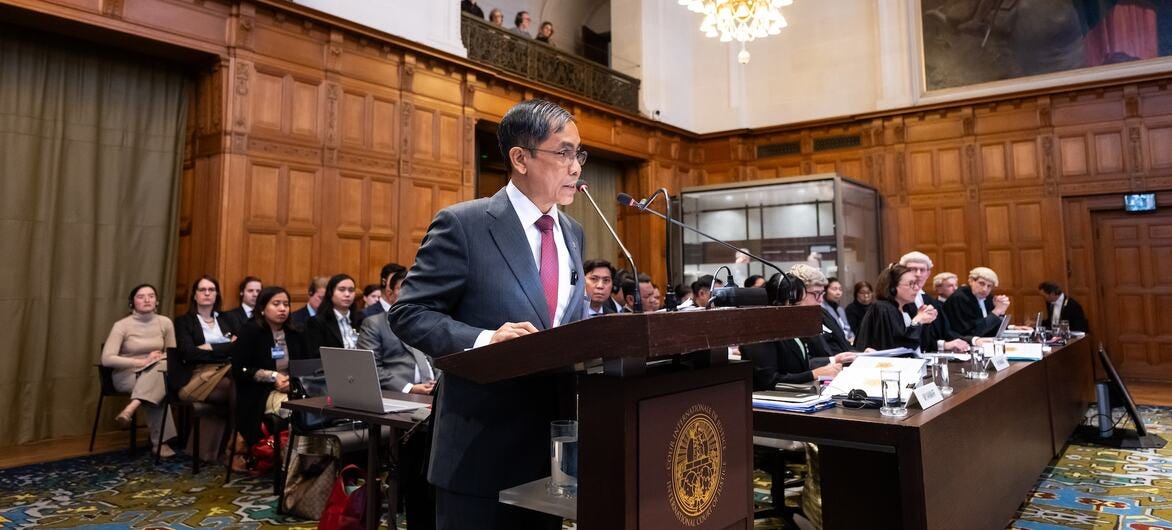
I (am glad to) see a lot Burmese folks cheering The Gambia’s case against Burma for its perpetration of genocide against the Rohingya. At the very least, this case exposes the brutality of the military junta to the world, and if it is successful (God-willing) it will further discredit them on the international stage. That, in itself, matters.
But the irony here is difficult to ignore.
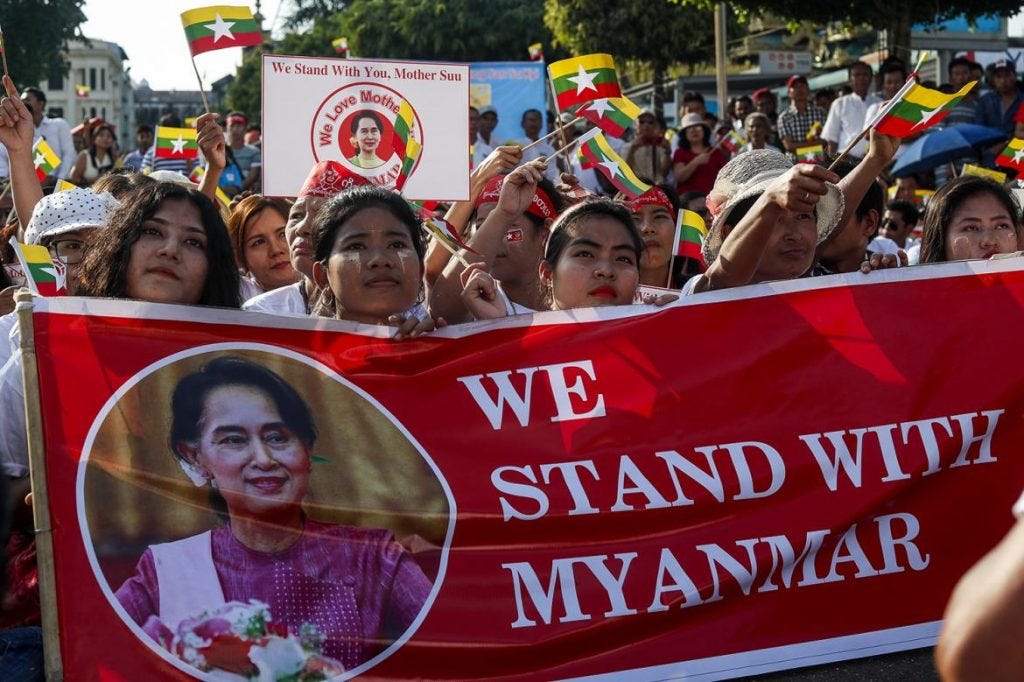
This newfound enthusiasm did not exist six years ago, before the coup, when “the Lady” stood before the world to defend the very same military and insisted that no genocide had taken place. We should not forget the widespread “We stand with Aung San Su Kyi” movement, mobilized precisely to shield her and to deny the Rohingya’s suffering (and even existence!). Let us also remember that the age old racist rhetoric “there is no Rohingya, only Bengali” was not (and is not!) fringe rhetoric. It was (and is) mainstream, repeated openly and without shame. At the time, solidarity with the Rohingya was not only absent but actively resisted.
The UN envoy Kyaw Moe Tun, back then, in effect, sold the narrative that the genocide was a “counter-terrorism” effort and that there was no such thing as “Rohingya.” Of course, with the changing of tides, he (along with the newly formed NUG) are forced, and I repeat, FORCED, to accept the Rohingya to push for their own agenda. It is, of course, obvious that this recognition is not born of moral clarity or genuine repentance, but of necessity. Otherwise, what legitimacy will they have on the international stage?
Now, however, when the same guns once aimed at the Rohingya have turned toward a different target (a target inward), many from that pro-Lady camp have suddenly jumped on the bandwagon. This shift, unfortunately, does not appear to stem from a genuine reckoning with the genocide or a commitment to justice and human dignity for fellow humans, the Rohingya. Rather, it serves a different agenda, one framed as the struggle for a “just” and “egalitarian” Burma.
Yet by “justice,” what often seems to be meant is a return to the pre-coup status quo: a Burma in which minorities remain perpetual “guests” (ဧည့်သည်) on their own land, even when they are indigenous to it and have, in many ways, contributed to and shaped the nation. I fear that the persistent rhetoric of forced assimilation, of insisting that Rohingya and Muslims (and other minorities) must “integrate,” submit, and conform to the “norms” of the counter even if it be “Bama-supremacy,” will still hold water even after Burma is liberated. Liberation, in this sense, does not dismantle hierarchy and systematic oppression; it merely rearranges it.
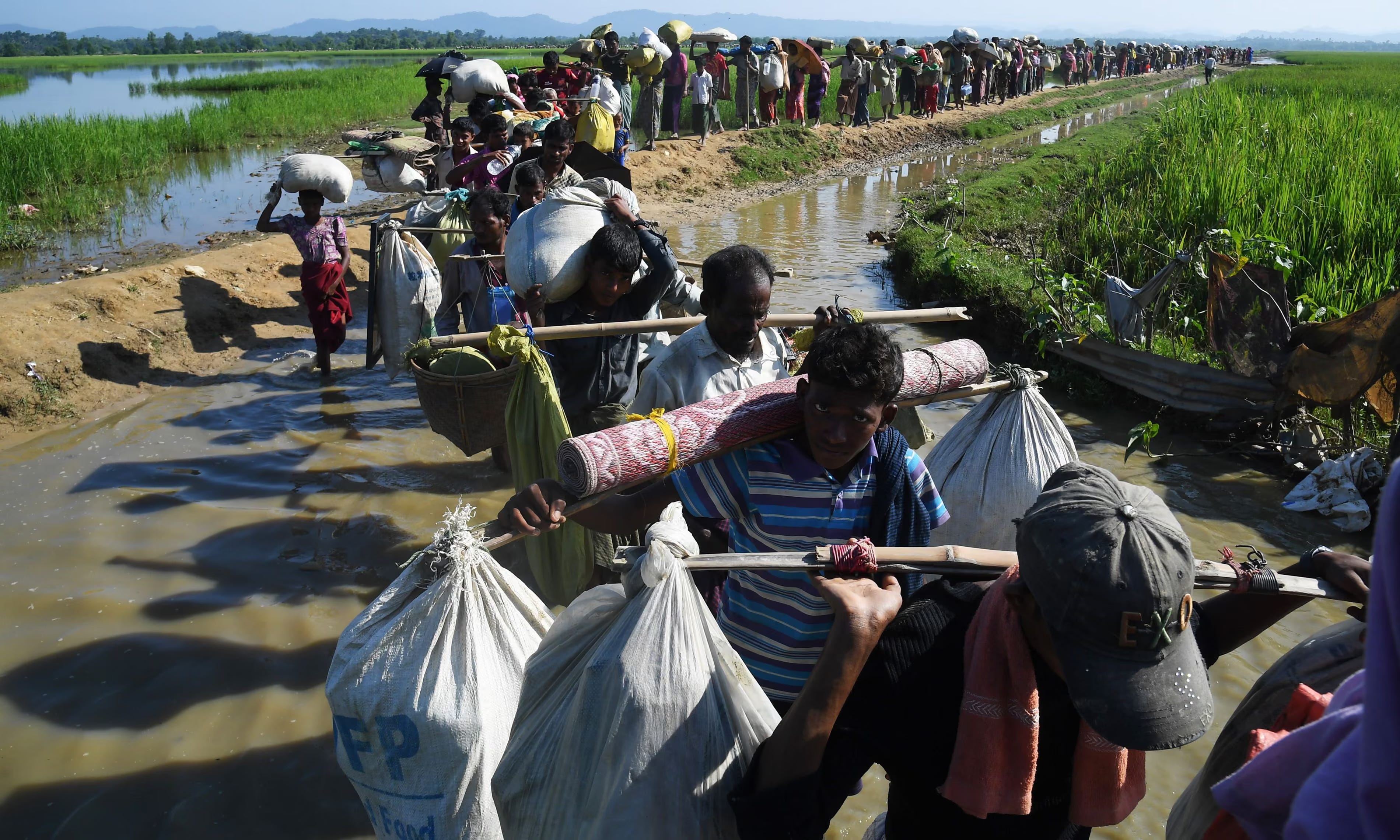
The Rohingya (at least to me, seems to) face a threefold challenge. The first is the political-genocidal violence inflicted by the military junta. The second (although less visible but no less dangerous) is the entrenched political and social racism that persists even in anti-junta circles and larger Burmese public, a sentiment that continues to deny the Rohingya’s belonging to Burma and that, in many ways, enabled the first crime. Too often, opposition to military rule stops short of confronting the deep ethno-nationalist assumptions that underwrite it. The Rohingya are routinely excluded from the moral imagination of the nation, spoken of as outsiders and (illegal) migrants rather than as a people with historical roots and legitimate claims to belonging. It is precisely what made the first crime possible. Genocide does not begin with violence alone, but with the normalization of exclusion, the quiet consensus that some lives do not fully count.
The third, and most painful of all, is how readily segments of the broader Burmese Muslim community in Burma are willing to throw their fellow Muslims under the bus, driven by racist and classist sentiment. We rather fight amongst ourselves along sectarian lines of bidʿa and kufr rather than for the protection of fellow Muslims. It is as we do not recite the Qurʾān when our Lord asked “And what is [wrong] with you that you do not fight in the cause of God and for the oppressed—men, women, and children—who say, ‘Our Lord, take us out of this town whose people are oppressors’?” (Q 4: 75) or when the Prophet told us that we are like one body, that when one part of it in pain, the whole body feels it (Ṣāḥīḥ Muslim).
Until all three of these realities are confronted, justice for the Rohingya will remain conditional, fragile, and perpetually postponed. And any so-called liberated Burma, if it is ever to materialize, risks reproducing the very structures it claims to oppose: a Burmese-supremacist, neo-fascist order designed for the “pure-blood” Burmese-Buddhist majority, where ethnic and religious minorities continue to exist only, at best, as tolerated presences. In such a future, the Rohingya, along with other minorities, would remain guests, never equals, and the cycle of exclusion, violence, and denial would simply repeat itself under a new banner.
I admit that I have no concrete solutions to propose at this stage but mere criticisms. And it won’t be wrong to point out that these criticisms may sound like empty words, reflecting my privileged position writing from across the world in a foreign language. That is a fair charge, and one I do not dismiss. But I maintain that my criticism, even when imperfect, is not entirely meaningless. Naming uncomfortable truths, especially those that are ignored, denied, and postponed, is itself a refusal to participate in collective amnesia. Silence has never been neutral in Burma’s history, and it has never been harmless. If these words do nothing else, let them at least resist the urge to move on too quickly as things that should be addressed and fixed (if ever) later or to imagine liberation without serious reckoning, not just for the atrocities committed against the Rohingya, but for Burma’s identity.