

Logic, God, and al-Ghazālī
Reflections from my podcast interview with Believing Academics

In August 2023, I was invited by Believing Academics, a podcast hosted by the Student Council at The Islamic Seminary of America (TISA), to discuss my research on al-Ghazālī1 (d. 505/1111) and his use of Aristotelian logic.2 Earlier that summer, I had presented this research at the University of Chicago as part of my Mellon Mays Research Fellowship in a talk titled “Logic as a Determinant of Scriptural Interpretation: Revisiting al-Ghazālī’s Hermeneutical Approach.” In both the presentation and the podcast interview, I explained the central role that Aristotelian logic plays in al-Ghazālī’s Qānūn al-taʾwīl (The Rule of Figurative Interpretation)—his hermeneutical framework wherein he argues that the literal meaning of scripture can be dismissed whenever demonstrative proof (burhān) can be established to show its impossibility.
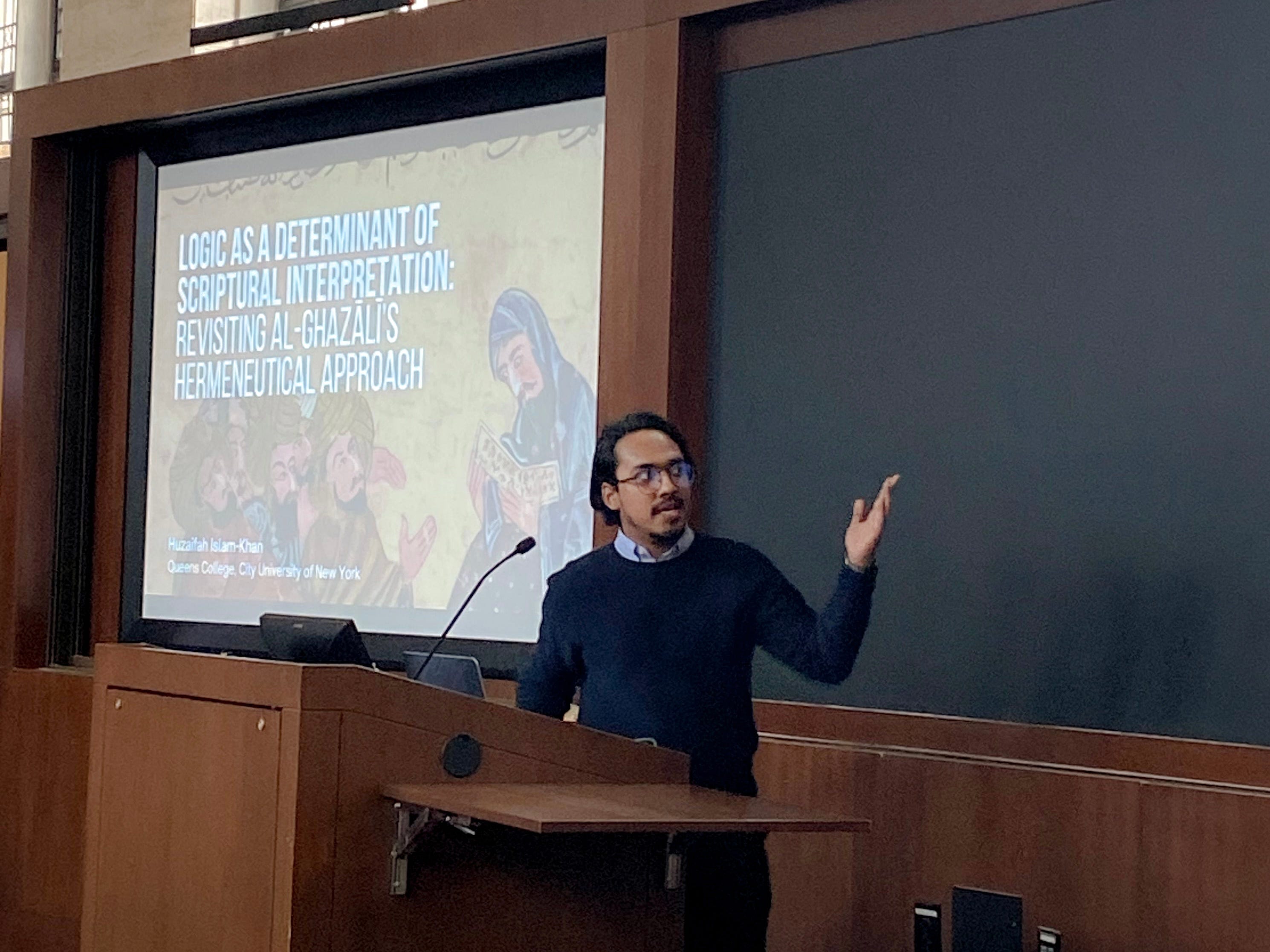
The research demonstrated a few key points. First, contrary to popular belief, logic can play—and does play—a central role in faith, so much so that, in this case, it became a primary tool for understanding not only God’s word but also God Himself. Second, it challenges an old but still popular view that al-Ghazālī was anti-rationality and that he was responsible for ending the Islamic golden age.3 Instead, my work shows how seriously al-Ghazālī took logic (and, by extension, philosophy) as a discipline, “neutralizing” it into mainstream Islamic theology (particularly Ashʿarism) and redefining the study and methods of Islamic theology itself. This actually adds to the rather complicated relationship al-Ghazālī had with philosophy—which was the subject of my MA thesis. Finally, my research aims to hint at the fact that Aristotelian logic—much contrary to what al-Ghazālī might himself have thought—wasn’t merely an “empty tool” used in reasoning properly but was embedded with metaphysical presuppositions. Hence, by employing Aristotelian logic in the formation of his hermeneutical framework, al-Ghazālī was implicating his overall understanding of ontology and, particularly, his understanding of God’s nature and attributes with that of the Peripatetic school.4
It should be noted that originally, this research was conceived as the first part of a two-part master’s thesis investigating how al-Ghazālī and Ibn Taymiyya5 (d. 728/1328)—two giants of competing Sunni theological schools—viewed logic and appropriated it within their own respective theological and hermeneutical paradigms. However, as my research progressed, I ended up zooming in on al-Ghazālī alone and his rather complicated relationship with philosophy. Not only that, but after having done more research since the podcast interview a year ago, I can’t help but feel that there were aspects that could have been clarified or contextualized differently, as well as points that could have been explained more accurately. To address this, I’ve edited the podcast transcript below—not only for readability but also to incorporate new insights from my research (post-podcast). You’ll find these updates and clarifications in the form of minor rephrasing of the original transcript, square brackets, and footnotes. Please note that this isn’t an exact word-for-word transcript.
If you’d prefer to listen to the original episode, you can find it linked here and also embedded below.
Podcast Transcript
As-salāmu ʿalaykum wa-raḥmat-ullāhi wa-barakātuh, everyone, and welcome to the TISA podcast. This podcast is produced by TISA students, and its aim is to spread the word about TISA and highlight the amazing work of Muslim scholars. TISA, or The Islamic Seminary of America, is the premier American Islamic graduate institution dedicated to cultivating a generation of world-class doers and thinkers who lead from an Islamic paradigm. In other words, TISA is in the business of marrying religious scholarship with ethical leadership.
In this episode, we speak with Huzaifah Islam-Khan. Brother Huzaifah is a teaching assistant at TISA and a writing fellow. He is also the co-founder and editor-in-chief of the Islamic Institute of Burma, which focuses on making Islamic knowledge more accessible in Burmese and empowering Burmese Muslims to engage with contemporary issues unique to their community.
Over the summer, Brother Huzaifah had the opportunity to present his research at the Mellon Mays Summer Symposium at the University of Chicago. His research topic was al-Ghazālī's incorporation of Aristotelian logic into Islamic theology and its effect in shaping his overall approach. Today, we'll learn more about that.
ME: As-salāmu ʿalaykum. Thank you so much for having me. My name is Huzaifah Islam-Khan, and I work as a teaching assistant and a writing fellow at TISA. I've been with TISA since its inception, al-ḥamdu lillāh, for about two [four] and a half years. My background is in philosophy, with a minor in Arabic studies, and I’m currently pursuing my MA in philosophy at the City University of New York. I specialize in Islamic philosophy and Islamic intellectual history. I’m in my final year of my MA, working on my thesis, al-ḥamdu lillāh.
It’s been an interesting journey because I didn’t initially intend to go into Islamic studies or philosophy. I started out in architecture, but TISA changed my mind about that. I audited a course, and I realized I couldn’t do architecture anymore—I had to go into Islamic studies.
What was the course that changed the course of your life?
ME: It was the very first course I took, ʿUlūm al-Qurʾān [Sciences of the Qurʾān], with Dr. Yasir Qadhi. That course blew my mind, and it really shattered a lot of what [I thought] I knew. [It made me feel like] I had to rebuild my understanding anew, and I couldn’t continue with my academic journey [in the same way].
I want to know just the brief summary—like the two-sentence summary of your research. Specifically the research you presented at the University of Chicago this summer. And what got you interested in this [topic]?
ME: My MA thesis is about the role of Aristotelian logic in Islamic theology.6 That’s a broad explanation of what I’m studying, [but it’s essentially] about how Aristotelian logic has influenced our understanding of Islamic theology. I’m focusing on al-Ghazālī and Ibn Taymiyya and their interaction with Aristotelian logic. At the University of Chicago, I presented on al-Ghazālī, in particular, as part of my thesis work.
Okay. And how did you become interested in Aristotelian logic?
ME: Since I study philosophy, especially Islamic philosophy, I have encountered different philosophical traditions like Neoplatonism and Aristotelianism. As a philosophy major interested in Islamic intellectual history, I started asking how these traditions impacted Islamic theology. I’m personally very interested in theology and ʿaqīda,7 and I’ve always been fascinated by how Islamic scholars [and theologians] interacted with these philosophical traditions and how, in this interaction, their understanding of Islam is produced. I chose al-Ghazālī and Ibn Taymiyya as my focus because they represent two main strands of Sunni Islam, and I find both of their approaches to be really intriguing.
Okay, just curious—when you studied philosophy, you weren't necessarily approaching it from an Islamic perspective. Did you notice any mention of Islamic philosophy in the curriculum, or is Islam largely absent from the Western presentation of philosophy?
ME: If you study philosophy at the undergraduate or even graduate level [in the West], Islamic philosophy is generally out of the picture. You study Aristotle, Plato, and the ancient Greeks, then jump right into Descartes or maybe Thomas Aquinas, where over at least 800 years [of history of philosophy] in between are lost.8 Here is where thinkers like Ibn Sīnā [Avicenna] and Ibn Rushd [Averroes], all these figures of traditional Islamic philosophy, are just skipped over. This omission is something even people within the Academy critique—it’s a very Western-centric [or Eurocentric] approach to studying philosophy. Philosophy didn’t just begin with Socrates. There’s also Buddhist philosophy, Hindu philosophy, and, of course, Islamic philosophy. So, it's usually skipped [over], and I’ve had to make a conscious effort to communicate to the faculty at my program that I’m interested in Islamic philosophy. Thankfully, while they don't offer exclusive classes on Islamic philosophy, they’ve allowed me to pursue independent studies, which has been helpful, al-ḥamdu lillāh.
Even within traditional Islamic studies, philosophy is often seen as a borderline subject, something that’s sometimes advised against.
ME: Right. It’s interesting because "philosophy" means different things depending on who’s using the term. When we talk about “philosophy” in the Western canon [in the broad sense of the word], we’re referring to [any] intellectual tradition consisting of ideas and methods [or rational method of inquiry]. Defined this way, it would definitely include figures like Ibn Taymiyya and al-Ghazālī, who engaged deeply in intellectual inquiry, even if we don’t label them as "philosophers" in the Western [or English] sense [of the word]—although we do call them theologians and jurists.
But typically, when people refer to "Islamic philosophy" within Western academia, they mean a very specific Graeco-Arabic tradition—[represented by] thinkers like Ibn Sīnā, Ibn Rushd, al-Fārābī, and al-Kindī, who engaged with Aristotelian and Neoplatonic thought and "Islamicized" or "Arabicized" it. This is often referred to as falsafa [in Arabic]. It’s this falsafa tradition that traditionalist scholars often caution against studying. But if we broaden the definition of philosophy, it could encompass other intellectual traditions within Islam, like ʿaqīda [theology], Ashʿarism, and Māturīdism [etc.].
So, it really depends on how you define philosophy. Within the Western canon, Islamic philosophy is usually equated with falsafa. The one borderline figure who might be acceptable in both traditional Islamic [study of theology] and academic circles [in the study of philosophy] is al-Ghazālī.
That’s an interesting point. So, now that we have a better understanding of philosophy and how it can have broader definitions that don’t necessarily contradict Islamic beliefs let's focus on your thesis. You're examining how al-Ghazālī interacts with and adopts Aristotelian logic. But before we dive into that, I know there are some foundational concepts we need to understand first. Could you start by explaining what anthropomorphism is and why it’s a key concept before understanding al-Ghazālī's arguments?
ME: Sure. To give a bit more context, I’m studying how al-Ghazālī and Ibn Taymiyya interact with Aristotelian logic and how their reception [of logic] influences their interpretation of scripture or revelation [naql]—specifically, how they understand God’s attributes or al-asmāʾ wa-l-ṣifāt.
So, anthropomorphism [within this context] refers to verses or descriptions in revelation that attribute human-like qualities to God. For example, references that describe God as having "hands" or "eyes" can sound anthropomorphic because they ascribe human-like characteristics to Him. The term can even apply in stories where animals are portrayed with human traits, like speaking or acting like humans. But within the Islamic tradition, when God is described in human-like terms, those descriptions are considered anthropomorphic in nature. I hope that clarifies it.
So, I understand what anthropomorphism is. Your argument, if I’m correct, is that al-Ghazālī finds Aristotelian logic and then uses it to interpret scripture, especially verses that might be considered anthropomorphic. Is that accurate?
ME: Yes. Al-Ghazālī, like many Islamic theologians, was troubled by these [anthropomorphic] verses from the beginning. The question was: how do we interpret texts that seem to refer to God in human-like terms, given that God is not like anything? This debate has long existed in Islamic tradition. Al-Ghazālī tried to address this issue by adopting Aristotelian logic and using it as a framework not just for [interpreting God’s] anthropomorphic attributes but for interpreting scripture in general, setting up parameters on how scripture should be interpreted.
I’m not sure if you want to delve into this now, but he says that whenever scripture contradicts what he calls demonstrative reasoning or burhān, then scripture should be interpreted figuratively.9 However, he's not suggesting we interpret scripture figuratively whenever we feel like it. He specifies that the only time we’re allowed to contradict or negate the literal wording of scripture [by reinterpretation] is when it contradicts demonstrative proof.
To give a bit more context, within Aristotelian logic, there are three types of reasoning. The first, or lowest level, is rhetorical reasoning. This is reasoning that’s widely accepted but isn’t grounded in rigorous logic. For instance, a common belief might be, "If you eat two different types of food together, you’ll get food poisoning." It's a claim people accept without scientific or logical proof just because it is commonly said around the household.
The second type is dialectical reasoning. This reasoning is based on premises that most people have already agreed upon. In Islamic theology, for example, Muslims start from the shared belief that God exists, and reasoning flows from there without needing to prove God's existence from scratch. This is why kalām, or speculative theology, is considered dialectical—it builds on agreed-upon premises.
The third and highest level of reasoning is demonstrative reasoning, which is based on first principles that leave no room for doubt. According to Aristotle, very few things can be proven demonstratively, but if something is, it becomes an undeniable fact.
Al-Ghazālī argues that if something is proven demonstratively, and the literal wording of scripture contradicts it, that’s the one [and only] instance where scripture should be interpreted figuratively. This principle is what he calls Qānūn al-taʾwīl, or the Rule of Figurative Interpretation. It shows how much he is convinced by Aristotle’s [logical] framework and integrated it into his approach to [understanding] scripture. I hope that's helpful.
Yeah, that's really helpful. So, let's define what taʾwīl and tafwīd are.
ME: Let’s start with tafwīd. Essentially, it means entrusting or delegating. In Islamic theology, especially within kalām, tafwīd refers to a stance where, upon encountering a verse whose meaning isn’t clear, you delegate its meaning to God. In other words, you say, "I don’t know what it means; I’ll just entrust it to God," and you abstain from trying to interpret it. The technical term I am thinking of calling it is “interpretive abstinence.”
However, it’s worth noting that tafwīd doesn’t mean exactly the same thing across all theological schools. For instance, the kalām schools—[like] the Ashʿarīs and Māturīdīs—on one side, and the Ḥanbalīs on the other, approach tafwīd differently. When they use the word “tafwīd,” they mean different things.10
For the Ḥanbalīs, tafwīd means that when you encounter a verse, particularly one related to God’s [anthropomorphic] attributes—such as "God rises over [istiwāʾ] the throne"—you affirm its apparent or literal meaning but avoid asking "how" [bi-lā kayf]. So you would say, "God rises over the throne in a way that befits His majesty," accepting the literal meaning but without speculating about its exact nature.
That’s the Ḥanbalī approach.
ME: Right. Now, for the Ashʿarīs and Māturīdis, tafwīd is a bit different. When they come across verses like "God rises over [istiwāʾ] the throne," they maintain that since God is not bound by time [and space]—as established by the kalām cosmological argument—they say that istiwāʾ in this verse cannot mean rising over the throne like it is literally understood. Instead, according to them, the literal meaning of the word [istiwāʾ] is negated, and once it is negated and since the [new or intended] meaning is not known, they entrust its actual meaning to God in this context. This way, they avoid committing to any anthropomorphic interpretation, leaving the real meaning to God.
Taʾwīl, on the other hand, is figurative interpretation. Although the term literally means "interpretation," here it specifically refers to figurative interpretation. It is to interpret something metaphorically [or figuratively]. For instance, calling someone "a lion on the battlefield" doesn’t mean they are literally a lion. That’s a metaphor [or a figure of speech]. Taʾwīl is just a metaphorical [or figurative] interpretation, but it’s only used under particular conditions, as outlined by al-Ghazālī.
In summary, tafwīd is about abstaining from interpretation (interpretive abstinence), while taʾwīl is figurative interpretation. So those are two different approaches.
Okay, but really, it's three different approaches.
ME: Yes, if we distinguish between the two types of tafwīd, it does result in three different approaches.
And where does Imam al-Ghazālī fall among these three approaches to scriptural interpretation?
ME: Al-Ghazālī, like the Ashʿarīs, accepts both tafwīd and taʾwīl. The Ḥanbalī are a different camp. They have a whole entire thing against taʾwīl. I don't want to make general statements about that. But generally, the Ashʿarīs and al-Ghazālī himself would accept tafwīd and taʾwīl. For him, when [a layperson] is faced with an anthropomorphic verse, the default is tafwīd, and you leave it at that. This means you reject the literal meaning and leave the true [actual and intended] meaning to God. However, he permits taʾwīl for a specific group of highly qualified scholars. He's not even talking about general scholars. He's talking about a very specific set of scholars. For these scholars, he says that they can do taʾwīl. He then produces his Qānūn al-taʾwīl, or the Rule of Figurative Interpretation or the Canon of Figurative Interpretation, which sets the guidelines for when taʾwīl can be done. According to him, the default is to read scripture literally, but if a literal interpretation is problematic, tafwīd should be used [for lay people]. But if you are a qualified scholar, you may do taʾwīl as per the rules that he comes out with [in his Qānūn al-taʾwīl]. So that's what al-Ghazālī would say.
So I guess my question is, what is the demonstrative proof he's pointing to, to say, "This is the reason I can abandon the literal meaning and go to another layer of meaning"?
ME: For al-Ghazālī, it seems he's very convinced that you can demonstrably prove God is not anthropomorphic in the way scripture might initially [and literally] suggest. He argues that you can show through demonstrative proof that God doesn’t have a hand, doesn’t occupy space, isn’t bound by time, and so on. He’s convinced you can prove this through burhān or demonstration.
To put it in modern terms, it’s like knowing the Earth is round—we take it as scientific fact and wouldn’t claim anything else. Similarly, al-Ghazālī sees God’s transcendence beyond physical form as a fact, which to him is demonstrable through reason and kalām cosmological argument. Hence, this knowledge is a demonstration or burhān for him. This is where he is starting. Given that certainty, he argues that this demonstrative knowledge must take precedence over the literal wording of scripture. Since we know, through demonstration, that God cannot occupy space or time and cannot have parts, he believes we have to prioritize this interpretation over a literal understanding of scripture.
It seems like philosophy wasn’t the basis of his belief but rather a means to convince others of what he already believed.
ME: That’s a tricky thing because there’s an ongoing debate about al-Ghazālī’s attitude toward philosophy. There is always the question of how al-Ghazālī views philosophy. When we talk about "philosophy," are we referring to a mode of inquiry or a specific tradition [like falsafa]? This is a complex topic on its own.
In my research, I’ve found that al-Ghazālī has a specific epistemological framework that he operates. He describes three modes of human cognition [or ways of knowing]. The first and lowest level is taqlīd or blind imitation. This is where you do something simply because someone else told you to. For example, you go to the doctor and follow their diagnosis and treatment without fully understanding it yourself. This, for him, is the lowest form of knowledge—it doesn’t lead to certainty.
That’s essentially what children do.
ME: Exactly. And he believes most people operate at this level, even some religious scholars. In his al-Munqidh min al-dalāl [The Deliverance from Error], al-Ghazālī describes this as his own struggle. He says he didn’t know anything for certain; he’d been doing taqlīd his whole life—taking everything on authority without personal inquiry. His [intellectual-spiritual] crisis starts from realizing this.
The second level, which is higher than taqlīd, is knowing through demonstration and logical reasoning from first principles. If something can be known through demonstrative proof and logical reasoning from first principles, it provides intellectual certitude or yaqīn. This is the level where he places philosophical reasoning, as it can produce certainty.
But for al-Ghazālī, there’s an even higher level of knowledge: maʿrifa [gnosis], or direct experiential knowledge, also called dhawq [tasting]. This is where his Sufism comes in. Maʿrifa isn’t just knowing about something; it’s experiencing it firsthand. He gives an example: imagine I tell you there’s someone in the other room. And since you believe me, you’ll believe that’s true—that’s taqlīd. That's the lowest level of knowing. If you hear the person’s voice from the other room, you deduce that someone is there—this is a demonstration, and it brings certainty. But if you walk into the room and see the person yourself, that’s maʿrifa—knowledge through direct experience—which he considers the completion [or perfection] of knowledge. Essentially, this is where al-Ghazālī's epistemology rests.
For al-Ghazālī, maʿrifa can only be attained through Sufism and the mystical path. While trained individuals can understand demonstrative knowledge, which is the second-highest form, the knowledge through maʿrifa and dhawq is deeply personal—it’s something you can only know through direct experience. I can describe sweetness to you, but you’ll never truly understand it until you taste it yourself.
So, al-Ghazālī’s engagement with philosophy—specifically, not just falsafa but as a mode of reasoning and inquiry—corresponds to the second way of knowing. It can produce intellectual certainty. But maʿrifa, which is derived from Sufism, produces certainty in the heart and soul. That’s the highest level in his tripartite epistemology, and that’s my understanding of his relationship with philosophy.
Okay, that makes sense. I guess I’m still wondering—when you were talking about how he would need demonstrable evidence to break away from a literal reading of scripture—doesn’t it seem like he's not actually discovering anything [new]? He’s calling on something he already believes to be true. That is, he already holds it as truth that God couldn't have these human or man-like qualities. Does that make sense?
ME: Yeah, that makes sense. It seems to me that in al-Munqidh min al-dalāl, al-Ghazālī discusses this, and he says that he doesn't know anything for certain except three things: [1] that there is God, [2] that the Prophet is the true messenger, and [3] that there is a Day of Judgment. These are things he says he knows from the heart. But beyond that, he claims he doesn’t have knowledge of anything else—he has thrown it all out and has to figure things out for himself. That’s where he begins. In that sense, yes, we could argue that he seems to have already made up his mind and is just trying to prove it through philosophy. But I don’t think there’s a conclusive way of saying that because his thoughts appear to have been influenced by philosophers, like Ibn Sīnā in particular. Al-Ghazālī seems to be extremely influenced by him. So, if he's influenced by Ibn Sīnā, and if we accept a certain argument within the academy—which I find quite convincing—then he’s trying to find a middle ground between the theologians on one side and the philosophers on the other, aiming for a synthesis between them. If we take that reading of him, then it’s not that he’s already made up his mind; he’s actually convinced, at least partially, of what the philosophers are arguing, at least to a certain degree, and is trying to synchronize it with his understanding of scripture. Through this process, he develops his view of God’s attributes, if you will.
Interesting. So, going back to his use of Aristotelian logic—borrowing from it—we’ve studied in class how ideas often seep into other communities, and there’s no restricting ideas. How did these ideas reach al-Ghazālī? Were they imported into his society? Was it simply because he was living in a time when philosophy and Aristotelian logic were widespread, so he naturally adopted them?
ME: Before al-Ghazālī’s time, Muslim theologians had already been interacting with the philosophers of the Peripatetic School, like Ibn Sīnā, al-Fārābī, and al-Kindī. Their works had achieved a certain level of intellectual prominence—much like how liberalism or other ideologies have become prominent in modern America. Al-Ghazālī himself would likely have studied these works while studying with al-Juwaynī, his teacher. Al-Juwaynī seems to have been one of the first to directly engage with and adopt certain aspects of Ibn Sīnā’s thought. So al-Ghazālī would have studied logic and parts of philosophy with al-Juwaynī, who even produced proof for God’s existence, using a contingency-and-necessary argument he got directly from Ibn Sina. Al-Ghazālī would have had access to all this through his teacher, al-Juwaynī, and not only through him but also because these ideas were prominent at that time. This was the main intellectual discourse taking place in his society.
Was this intellectual discourse confined to certain geographical pockets, or was it widespread? Had philosophy infiltrated the broader intellectual scene?
ME: I don’t want to say it was everywhere across the Muslim world, but it was definitely prominent in Central Asia, especially in the Middle East—particularly in regions like Iran and Iraq. Those areas were hotspots for philosophical thought, especially because of the influence of figures like Ibn Sīnā and al-Fārābī.
Okay. So, the groundwork was already laid as he was growing up, and he absorbed these ideas in his early education. Do you think it’s problematic to employ a foreign framework, like Aristotelian logic, to interpret scripture?
I think that depends on who you’re asking.
Do you think al-Ghazālī found it problematic? Obviously, he used it, but do you think he had any reservations?
ME: I don’t think he saw it as problematic. Interestingly, he seemed to believe that philosophy, or “original” philosophy from figures like Aristotle and Socrates, actually had a prophetic origin. He thought logic wasn’t something Aristotle invented; rather, it was something prophets like Abraham, Moses, and prophets of old possessed. Al-Ghazālī even writes about this. He suggests that philosophers merely adopted and preserved this knowledge, though in a way that became mixed with falsehood over time—much like how Islam views Christianity and Judaism as containing some truth but corrupted. So, he sees philosophy in a similar light, where logic [is one of the disciplines that] has been preserved “purely” within the philosophical tradition, while metaphysics has issues due to corruption by philosophers. He sees philosophy as a revealed science from God, so he definitely doesn’t think of it as foreign. He sees it as rediscovering knowledge, much like if one were to come across the Bible or Jewish scriptures.
Does al-Ghazālī cite instances of the Prophet Muhammad (ﷺ) employing Aristotelian logic during the Prophet’s lifetime?
ME: Al-Ghazālī has a treatise called al-Qisṭās al-mustaqīm (The Correct Balance), where he lays out five principles of logic. In this book, he provides both a rational and scriptural basis for these principles. He argues that these five principles are found in the Qurʾān, and he cites various verses to support his claim. One example he gives is Abraham’s use of these principles in his debate with the polytheists of his time. Now, I can’t think of a specific example where the Prophet (ﷺ) used these exact principles, but al-Ghazālī definitely believes they are embedded in the Qurʾān. In a way, he “Quranicized” these Aristotelian principles, calling them “the balance.” This is because be believed that knowledge should be measured against these principles—which have a basis in both reason and revelation—and if knowledge conforms to them, it is sound; if not, it is unreliable.
So he’s convinced that there’s a basis in the Qurʾān. Are you convinced by his argument?
ME: Personally? I think that [the act of] reasoning exists within the Qurʾān, but I wouldn’t necessarily say that it’s exactly the same type of reasoning as found in Aristotelian logic. Throughout history, logic has evolved, and today, we have different forms, like the type founded by Gottlob Frege and modern philosophy. Each logical system has its strengths and weaknesses. But reasoning in general, yes, I think that’s implied within the Qurʾān. I’m just not convinced that it is exactly the same as Aristotelian logic.
It seems as though, for al-Ghazālī, logic is integral to attaining true faith. Would you say that's accurate?
ME: Yes, that's the highest way of achieving certainty in faith—as far as the intellect is concerned. There’s only one step higher than that, which is the knowledge of the soul—ma’arifa, dhawq, whatever you want to call it. But, as far as the intellect or the mind is concerned, logic is the highest way of attaining certain knowledge. The only exception to this is the path of the Sufis, which involves the direct experience of knowledge itself. Al-Ghazālī is convinced of the importance of logic, but he expects scholars of a certain rank to practice taqlīd to a degree. He’s speaking to a very specific group—what he calls the “elite of the elites” or mujtahids. These are the only people qualified to do ijtihād (independent reasoning) from the ground up.
In your research, do you explore whether this dichotomy between acceptance and rejection of logic persists today?
ME: Do you mean the dichotomy of accepting and rejecting logic? This is actually the second part of my research, where I focus on Ibn Taymiyya. He is highly critical of logic, but even he wouldn’t dismiss it entirely. He adopts certain aspects of it despite his criticism. I don’t think he would reject logic in its entirety because Aristotelian logic contains elements that are foundational to reasoning. I don’t think anyone would reject those. So, what we mean by “logic” is actually the bigger question here. Are we talking about Aristotelian logic or other forms of logic? [Or just a systematic and coherent way of reasoning in general?] Ibn Taymiyya is known for his suspicion and critique of Aristotelian logic, while al-Ghazālī is very certain of its framework.
My question is, how does this dichotomy persist or present itself in our current landscape?
ME: I think this comes up whenever an Ashʿarī and an Atharī, Ḥanbalī, or Salafi sit down and discuss God's attributes. The fundamental issue is their understanding of logic and the limitations of the mind [in its ability to understand the Divine]. Al-Ghazālī is convinced that God cannot be corporeal in any way. So, he rejects all anthropomorphic descriptions and insists on going down the route of taʾwīl, whereas a—very open-minded—Ḥanbalī, Salafi, or Atharī might say, "Sure, that's one possible way [of looking at it], but it’s not the only way." Ibn Taymiyya, for instance, develops an entirely different paradigm for understanding God's attributes, although he still adopts certain notions from Aristotle—like the Aristotelian notion of space. I think John Hoover has written a paper about this.11
Even Ibn Taymiyya does that. The point is that all these theologians couldn't help but interact with these philosophical ideas. They all did. They adapted [, reacted, and neutralized] it with their [pre-existing] knowledge, just like today. We see this entire genre of "scientific miracles" in the Qurʾān—a modern response to what we think as “scientific” knowledge. So, this is how it plays out: how we interact with scripture and the limitations we place on our understanding of it. Al-Ghazālī, for example, is not limiting scripture itself. He's actually giving it a lot of leeway by saying scripture should be taken literally except in one specific instance when it absolutely requires figurative interpretation. This is the opposite of what the philosophers would say, as they saw most of scripture as metaphorical. Nothing in it is to be taken literally. Al-Ghazālī is really going against the grain here to emphasize that it should be taken literally.
Yeah, and I think that’s an important point. It seems like the center is always moving. In his time, maybe al-Ghazālī was moving public opinion toward a balanced middle ground because he was dealing with the extremes of the philosophers. But today, our center is much more conservative and strict in interpretation, so some might see his ideas as a bit too lenient. I think that it really depends on the historical context.
ME: Absolutely. He’s trying to provide a coherent way of looking at scripture, giving it a lot of authority by making only one exception to literal interpretation. And what strikes me when I read both Ibn Taymiyya and al-Ghazālī is just how shocking their statements are. They say things that, if someone said today, would probably get them labeled as a mubtadiʾ [heretic].12 For example, al-Ghazālī claims that philosophy originates with the prophets of old—that figures like Socrates and Aristotle somehow got philosophy from God or revelation. I was taken aback, like, "On what basis are you arguing this?" because he doesn’t quote any ḥadīth or Qurʾānic verses to back it up. He takes it for granted.
Then you have Ibn Taymiyya, who proposes that hellfire might not be eternal and entertains the idea that the universe could be eternal, being perpetually created by God. This was a huge debate. Al-Ghazālī is firm that the universe isn't eternal, and he even issues a fatwa at the end of the Tahāfut al-falāsifa [Preciptiance of the Philosophers], saying that anyone who believes that the universe is eternal is a kafir [disbeliever] and should be executed. But then Ibn Rushd responds, saying that you're claiming scripture definitively states the universe isn’t eternal, but scripture also mentions that before God created the heavens and the earth, His throne was on water. And that God created the heavens and the earth from gas. This implies that something existed before the creation of the heavens and the earth.
When they talk about the eternality of the universe, they don’t mean the universe as we mean it today. For them, "universe" simply means anything that exists apart from God—matter, water, whatever. The philosophers believed something always existed. Then Ibn Taymiyya comes along and proposes “perpetual creation,” which, to me, seems like a middle ground between the philosophers and al-Ghazālī. God is perpetually creating one thing after another, but nothing created is eternal in itself. It’s an original take, and they had so much intellectual leeway. Today, if we explored ideas like these, it would probably be problematic.
We’d be canceled! Why do you think they had so much freedom to come up with creative ideas like this?
ME: Honestly, I don’t know. I'm still looking into it, but I suspect there was a broader socio-political context at play. They lived in a time when Islam was dominant, mostly in Muslim lands, so they had the freedom to make interpretive leaps without risking their faith status. Today, if you make an interpretive leap, you risk immediate condemnation. It also depends on the paradigm and the community you’re in. I found al-Ghazālī’s claim about philosophy originating in revelation interesting, and he’s not alone—other thinkers were also convinced of this. I might explore this further in my research to trace where this motif comes from.
Overall, my research aims to give a clearer account of why these debates existed and how they engaged with what were considered “foreign sciences.” My MA thesis’s second part looks into Ibn Taymiyya’s critique of Aristotelian logic,13 which ultimately steers him away from taʾwīl and toward his own interpretive system. I find it fascinating and original, and I think it will make for an interesting comparison.
We look forward to hearing [about] part two of this journey. Jazakallah Khayr, thank you for listening to the podcast and supporting our work. Until next time, As-salāmu ʿalaykum wa-raḥmat-ullāhi wa-barakātuh.
I would like to extend my gratitude to the TISA Student Council and sister Nazish Mithaiwala, the host, in particular, for their gracious invitation and for giving me a platform to discuss my research.
Abū Ḥāmid al-Ghazālī (c. 448-505/1056–1111) was one of the most prominent and influential thinkers, theologians, jurists, and mystics in the history of Sunni Islam. For an overview on his life and ideas, see his entry on the Stanford Encyclopedia of Philosophy.
The renowned astrophysicist Neil deGrasse Tyson parroted this view: “[Al-Ghazālī’s] interpretation took over [the Islamic world]. And in that interpretation, it included the perspective that the manipulation of numbers is the work of the Devil. This cuts the kneecaps out of any mathematical advances that would unfold math as the language of the universe. If you take that out of your personal equation, you no longer contribute to the advance of human understanding of that universe.” Islam’s Rise and Fall in Science - By Neil deGrass Tyson, 2020; and see also The Intellectual Collapse of Islam, 2012.
This point about how ontological presuppositions of Aristotelian logic impacted al-Ghazālī’s understanding of God is something I am currently looking at (as of the writing of this blog).
Taqī al-Dīn Ibn Taymiyya (661-728/123-1328) was a Damascene thinker, theologian, jurist, and reformer best known today as a major inspiration for the Salafi movement. For an overview of his life and thoughts, see an entry on him in the Stanford Encyclopedia of Philosophy.
Although this was true at the time, my MA thesis became broader, and my topic changed from investigating al-Ghazālī’s use of Aristotelian logic to al-Ghazālī’s view on philosophy.
ʿAqīda is just an Arabic word for theology or creed.
I have to say this issue is being effectively addressed and amended by Dr. Peter Adamson’s excellent podcast, History of Philosophy Without Any Gaps.
I have replaced and corrected the word “metaphorically” with “figuratively” to reflect a broader sense of the Arabic word “majāz.” This is in following Wolfhart Heinrichs, who argues that majāz includes many other rhetorical devices besides metaphor. See Wolfhart Heinrichs, “On the Genesis of the Ḥaqîqa-Majâz Dichotomy,” Studia Islamica, no. 59 (1984): 111, n.1. For a short overview of the use of the word majāz as metaphor and the problems associated with it, see Farid Suleiman, Ibn Taymiyya and the Attributes of God, trans. Carl Sharif El-Tobgui, Islamic Philosophy, Theology and Science, volume 125 (Leiden ; Boston: Brill, 2023), 141, n.1.
Although what I said here about there being different understandings of tafwīd is not untrue, I think this is not as accurate as I’d have liked to have made it out to be. After reading Farid Suleiman’s argument in his monograph on Ibn Taymiyya, I believe it is better to differentiate three broad approaches—not two—to interpreting scripture, which is by making balkafa (or bi-lā kayf: “without how”) its own category and not (necessarily) as a subset of tafwīd. In this sense, the three approaches are (1) balkafa: to affirm God’s attribute and its modality without asking how (bi-lā kayf); (2) tafwīd: to affirm God’s attribute the way He attributed to Himself, but negating its literal meaning and leaving the intended actual meaning to Him; and (3) taʾwīl: to figuratively interpret God’a anthropomorphic attributes. For an in-depth and nuanced explanation, see Suleiman, Ibn Taymiyya and the Attributes of God, 64-9.
See Jon Hoover, “God Spatially Above and Spatially Extended: The Rationality of Ibn Taymiyya’s Refutation of Faḫr al-Dīn al-Rāzī’s Ašʿarī Incorporealism,” Arabica 69, no. 6 (December 21, 2022). For another thorough treatment of Ibn Taymiyya’s understanding of space (and time), as adopted from Aristotle, see Suleiman, Ibn Taymiyya and the Attributes of God, 116–25.
I was mistaken here when I said they didn’t get into trouble in their times for their “eccentric” positions. Much to the contrary, both al-Ghazālī and Ibn Taymiyya did indeed get into trouble with the scholars and authorities of their time—the latter more so than the former. Al-Ghazālī, for instance, was accused of being a philosopher and a heretic whose books mix “unbelief” and “falsehood” with the truth of revelation, so much so that it seem to be one of the main motivations for writing his “apologetic autobiography” al-Munqidh min al-dalāl (The Deliverance from Error). See Alexander Treiger, Inspired Knowledge in Islamic Thought: Al-Ghazālī’s Theory of Mystical Cognition and Its Avicennian Foundation, Culture and Civilization in the Middle East 27 (London: Routledge, 2014), 96–101; Frank Griffel, Al-Ghazālī’s Philosophical Theology (Oxford: Oxford Univ. Press, 2010), 53–55. Similarly, Ibn Taymiyya, on seven different counts—no less—was imprisoned for many of the theological and jurisprudential positions he held and argued for. In fact, he died in prison. For an overview, see Suleiman, Ibn Taymiyya and the Attributes of God, 35.
Unfortunately, as mentioned in the reflection above, this never came to fruition due to a change in the topic of my thesis. I ultimately ended up narrowing my research to just al-Ghazālī alone. However, I plan to revisit Ibn Taymiyya and his views on logic in the future.